
Closing an entire building while refurbishment work takes place isn’t always practical. A hospital still has patients to care for. Employees may need to continue working. Schools, veterinary practices and other organisations can have areas or services that simply can’t stop because construction has started.
So, can you refurbish a building while it’s still operational?
In many cases, yes. But understanding how to refurbish an occupied building successfully means looking beyond the construction work itself.
In this blog, we explore why you also need to consider the people using the building, which areas and services need to remain available and how the works could affect everything happening around them.
What makes an occupied building refurbishment different?
When a building is empty, the programme can largely be organised around the most efficient way to complete the work.
In a live environment, there are other priorities.
Certain areas may need to remain accessible. Deliveries might need to avoid busy periods. Noisy work may only be possible at agreed times. Services might need to be isolated without affecting another part of the building.
There could also be people working, receiving care or carrying out other activities immediately next to, above or below the construction area.
At PCI, we’ve worked across live healthcare, education, veterinary and commercial environments. While every project is different, the principle is the same: the construction or refurbishment programme needs to work alongside the client’s operation, rather than expecting the operation to work around the construction.
Phased refurbishment can help keep the building operational
Rather than working across a large area at once, the project can sometimes be divided into phases,, allowing construction to progress while other areas remain available.
That might sound straightforward, but each phase can create its own dependencies.
Does one area need to be finished before people can move out of another? Will temporary access be required? Are there shutdowns or service alterations to coordinate? When do specialist contractors need access?
These questions need to be considered as part of the overall programme.
The aim is to create a realistic sequence that considers what the construction team needs to achieve alongside what the client needs to keep doing.
How can you minimise disruption during refurbishment?
Clients understandably want to know whether refurbishment can take place without disrupting operations. While it’s rarely realistic to promise no impact at all, good planning can help minimise and manage that disruption.
Putting up hoarding or segregating a work area doesn’t mean everything happening inside it stays there.
Noise travels. So can dust. Vibration from construction activity may affect other parts of the building, while deliveries and the movement of materials can interfere with normal access.
Depending on the project, controls can include careful segregation and signage, air cubes, on-tool dust extraction, dust mats and the selection of suitable construction methods.
Timing matters too.
Could noisy work take place during a quieter period? Can deliveries avoid the busiest times of day? Does an isolation need to happen outside normal operating hours?
We’re never going to pretend the refurbishment won’t have an impact. Our aim is to understand where that impact could be felt and plan how it will be managed.
Communication needs to continue once work starts
Even a well-planned refurbishment can change once construction begins.
Existing buildings can reveal unexpected issues. A specialist contractor might need access at a different time. An operational requirement may change. A delivery or shutdown could need coordinating with several different people.
Clear points of contact and regular communication make those situations much easier to manage.
For PCI, working in live environments means communicating with occupants and stakeholders, coordinating activities around their requirements and providing clear routes for decisions or escalation.
That means that when inevitable challenges arise, good communication means the right people know about them early enough to make practical decisions.
What does live hospital refurbishment involve?
Healthcare projects show why careful planning and coordination in a live environment matter.
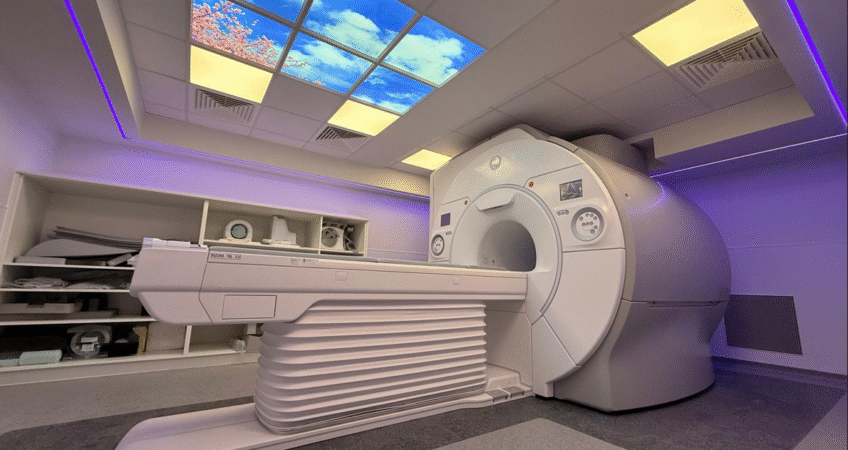
PCI’s £1.15 million refurbishment of the Imaging Department at Sloane Hospital was delivered over a 20-week phased programme. The project involved enabling works for a new MRI magnet and X-ray machine, alongside the refurbishment of clinical and non-clinical spaces, while the department remained safe and operational.
One of the more complex stages involved temporarily removing part of a structural wall to allow the MRI magnet to be brought into the building. Working within a live hospital meant the construction area had to be carefully segregated from public and clinical areas, with controlled access and close management of noise and disruption.
The project shows why live hospital refurbishment needs to be planned around more than the construction programme itself. Patient and staff access, specialist equipment, safety, disruptive works and the hospital’s ongoing operation all need to be considered as part of the delivery plan.
The same principle applies to an occupied office refurbishment. The risks in a workplace may be different to those in a hospital, but access, noise, deliveries, phasing and communication can still have a significant effect on the people using the building.
How disruptive will my refurbishment be?
It’s a reasonable question, but there’s no single answer.
The level of disruption depends on the building, the work involved and what needs to continue while construction takes place.
That’s why it can be more useful to ask a potential contractor how they intend to manage disruption.
Which activities are likely to affect your operation? When will they happen? How will areas be segregated? Will services need to be isolated? How will deliveries be managed? Who will communicate changes to your team?
A contractor should be able to talk through those questions before work starts rather than simply promising “minimal disruption”.
Planning refurbishment in an operational building
A live environment refurbishment isn’t simply a construction project happening behind a temporary wall. The building still has a purpose while the work is taking place.
Successful delivery means understanding what needs to continue, identifying where construction could have an impact and building those requirements into the programme.
With more than 40 years of construction and refurbishment experience, PCI has worked extensively across live healthcare, education, veterinary and commercial environments.
If you’re planning a refurbishment in a building that needs to remain operational, talk to the PCI team about your project and how the works could be planned around your organisation.